Agently, a Lindy AI Alternative: When You Want AI Employees, Not AI Workflows
Lindy AI has carved out a strong position in the AI agent space. It's a no-code platform for building autonomous agents that handle tasks like phone calls, email follow-ups, meeting scheduling, and lead enrichment. It's flexible, has a solid template library, and appeals to people who want to design their own agent workflows.
But "build your own agent" isn't what every team needs. Some teams don't want to configure workflows from scratch — they want AI employees that are ready to work out of the box, with built-in roles, tools, and business context.
This article compares Lindy AI with alternatives for teams evaluating their options. We publish this through Agently, which competes in the same space, and we'll be transparent about the trade-offs.
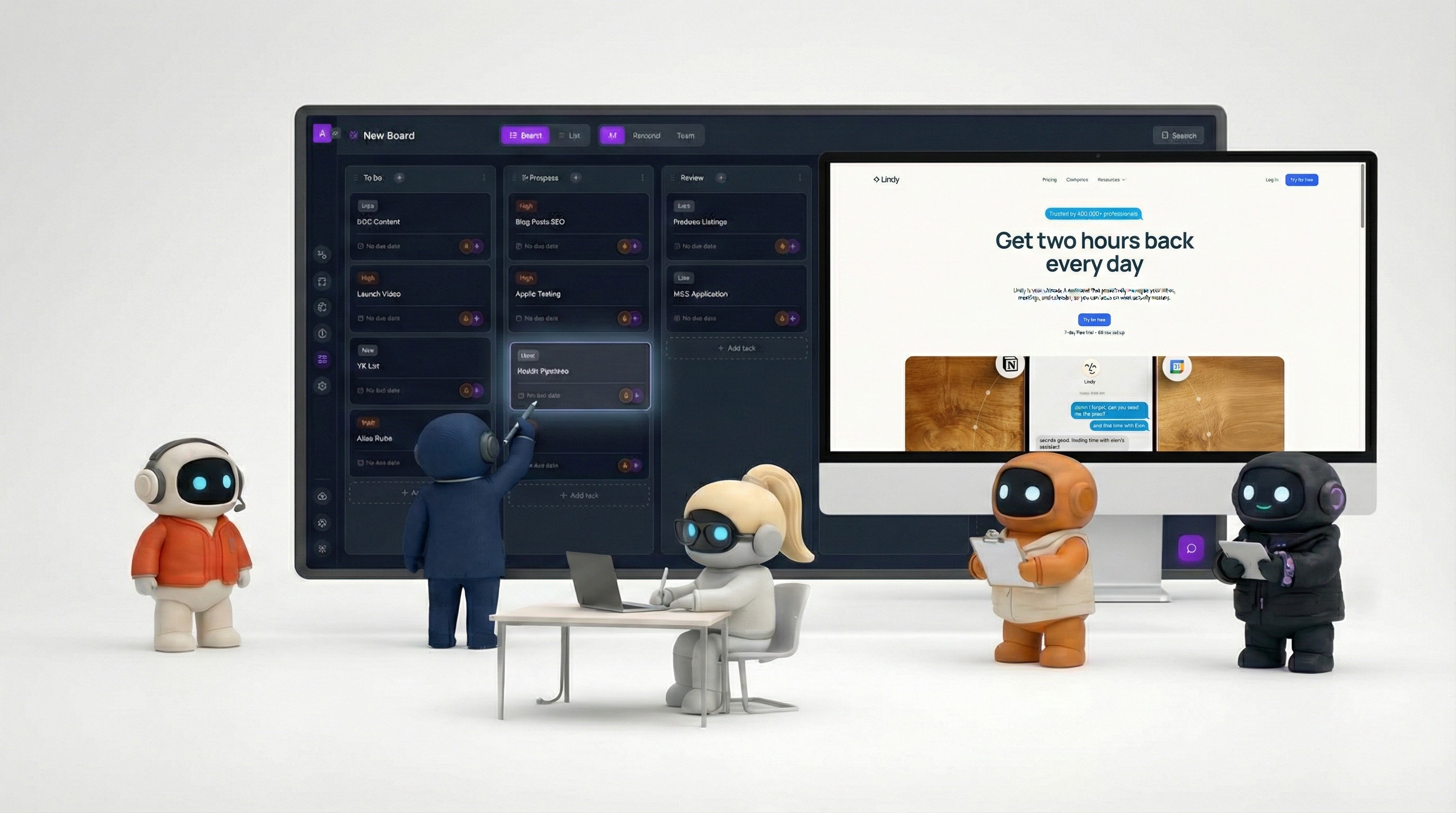
What Lindy AI Does Well
Workflow builder flexibility
Lindy's core strength is its no-code workflow builder. You can design agent workflows step by step — trigger conditions, decision logic, actions, follow-ups. For teams that want granular control over exactly how their AI agents operate, this flexibility is genuine and hard to match.
Voice and phone capabilities
Lindy stands out with phone call automation. Agents can make and receive calls, handle voice interactions, and integrate calling into larger workflows. If voice automation is central to your business (appointment setting, outbound calling, customer phone support), this is a real differentiator that most competitors don't offer.
Pre-built templates
While Lindy is a builder platform, it offers templates for common workflows — lead enrichment, meeting scheduling, email follow-ups, customer support responses. These give you a starting point rather than building from zero.
Integration breadth
Lindy connects to CRMs, email, calendars, Slack, and a range of other tools. The integrations feed into the workflow builder, so you can trigger agents based on events across your tool stack.
Free tier for testing
The free plan includes 400 credits, which is enough to test a few workflows and decide if the platform fits your needs before committing money.
Where Lindy AI Falls Short
You build everything yourself
Lindy's flexibility is also its overhead. There are no pre-built "sales agent" or "marketing agent" roles. You design the workflow, configure the triggers, define the actions, and test the logic. For technical teams or automation enthusiasts, this is a feature. For teams that want to start working immediately, it's a barrier.
The time between signing up and getting real value from Lindy is longer than platforms that come with ready-to-use agents. You're building the employee before you can put them to work.
Credit-based pricing adds up fast
Lindy's credit system means your costs scale with complexity. Simple tasks cost 1-3 credits. Complex multi-step workflows cost 5-10+. Phone calls consume around 265 credits each. A single lead generation campaign with knowledge base search, qualification email, and follow-up call can burn through 275 credits in one interaction.
On the Pro plan ($49/month for 5,000 credits), a team running several daily workflows can exhaust credits mid-month. Overages cost $10 per 1,000 additional credits. Voice features add $50-200+/month on top of base pricing.
No shared team workspace
Lindy is primarily a workflow automation platform, not a team workspace. There's no built-in document editor, no team channels, no shared Kanban boards. Your agents execute tasks, but the rest of your work — documentation, project management, team communication — happens elsewhere.
Agents are workflows, not colleagues
Lindy agents execute predefined sequences. They don't have persistent identities, role-specific knowledge, or the ability to hold open-ended conversations about your sales strategy or content plan. They're powerful automations, but they don't feel like working with a team member. If you want to brainstorm with your AI about campaign ideas or have it proactively suggest outreach strategies, that's not Lindy's model.
Voice quality varies
While phone automation is a differentiator, the quality of AI voice interactions is still uneven across the industry. Complex conversations, unexpected questions, or nuanced situations can trip up voice agents. It works well for structured calls (appointment confirmations, basic qualification) but less well for consultative or sensitive conversations.
Agently vs. Lindy AI: Feature Comparison
Feature | Lindy AI | Agently |
|---|---|---|
Approach | No-code workflow builder | Pre-built specialized agents |
Agent setup | Build your own from scratch | Ready-to-use with roles and tools |
Agents available | Custom (you design them) | 6 specialized + (Sales, Ops, Marketing, Support, Research, Guide) |
Voice/phone calls | Yes — a core feature | No |
Pricing model | Credit-based (400-30,000/month) | Subscription-based |
Starting price | Free (400 credits), Pro $49/month | Free tier available |
Knowledge base | Configurable per workflow | Shared Brain across all agents |
Team workspace | No | Yes — Spaces, Pages, Channels |
Document editor | No | Built-in (Pages) |
Task management | No | Built-in Kanban boards (Spaces) |
Team communication | No | Channels with agents and teammates |
Email integration | Send via workflows | Send through Gmail/Outlook in conversations |
Calendar integration | Schedule via workflows | Manage through Google Calendar, Outlook, Calendly |
Social media | Limited | LinkedIn, Twitter/X posting |
Conversational AI | Task execution | Open-ended conversations with role context |
Who Should Choose Lindy
Lindy is a strong fit if:
You need voice/phone automation. If outbound calls, appointment setting, or phone-based customer support is central to your operations, Lindy's voice capabilities are a genuine differentiator.
You want granular workflow control. If you're technically inclined and want to design exactly how your agents operate — every trigger, every condition, every action — Lindy's builder gives you that control.
You're an automation power user. If you've outgrown Zapier or Make and want AI-powered automations that can reason and decide, Lindy is the logical next step.
Your needs are specific and well-defined. If you know exactly what workflow you want to automate and can define it step by step, Lindy executes it well.
Who Should Consider Agently Instead
Agently fits better when:
You want to start working immediately. Pre-built agents with role-specific tools and knowledge mean you're productive in minutes, not hours of configuration.
You need a workspace, not just automation. If you want your AI agents, documents, tasks, team communication, and knowledge base in one place, Agently provides that unified environment.
You think in roles, not workflows. "I need a sales agent" and "I need a marketing agent" are more natural starting points than "I need to build a 7-step workflow with conditional branching."
Your team collaborates with AI. Multiple team members sharing the same agents, the same knowledge base, and the same project boards — with AI participating in team channels alongside humans.
You want predictable costs. Subscription pricing without credit limits means you don't ration agent usage or worry about overages.
You don't need voice automation. If phone calls aren't part of your workflow, Lindy's key differentiator doesn't apply to you.
Other Alternatives Worth Considering
Relevance AI — Another agent builder platform with a different approach to workflow design. More enterprise-focused with SOC 2 compliance and advanced analytics. Credit-based pricing with action and vendor credit separation.
Sintra AI — Pre-built AI helpers (12+) at a low price point. Credit-based, individually focused (no team workspace), but affordable for solopreneurs testing AI employees.
Zapier + ChatGPT — If your needs are closer to "smart automation" than "AI employees," combining Zapier's workflow builder with ChatGPT's reasoning might give you 80% of what Lindy offers at a lower cost. Less sophisticated, but simpler.
Making the Decision
The Lindy vs. Agently choice boils down to philosophy:
Lindy says: "Here's a powerful builder — design the AI agent you need." You invest time upfront building workflows, and you get exactly the automation you designed.
Agently says: "Here's a team of AI employees — tell them what you need." You start working immediately with pre-built agents, and you get a workspace where AI and humans collaborate.
If you enjoy building systems and want maximum control, Lindy rewards that investment. If you want AI that works like a new hire — show up, get context, start delivering — Agently takes that approach.
Neither is universally better. Test both with a real workflow from your business. The one that gets you to value faster, with output quality you trust, is the right choice.
Agently's AI employees are ready to work from day one — no workflow building required. Try it free with your team.
CEO
Omar Ghandour
February
28,
2026
Share on social media