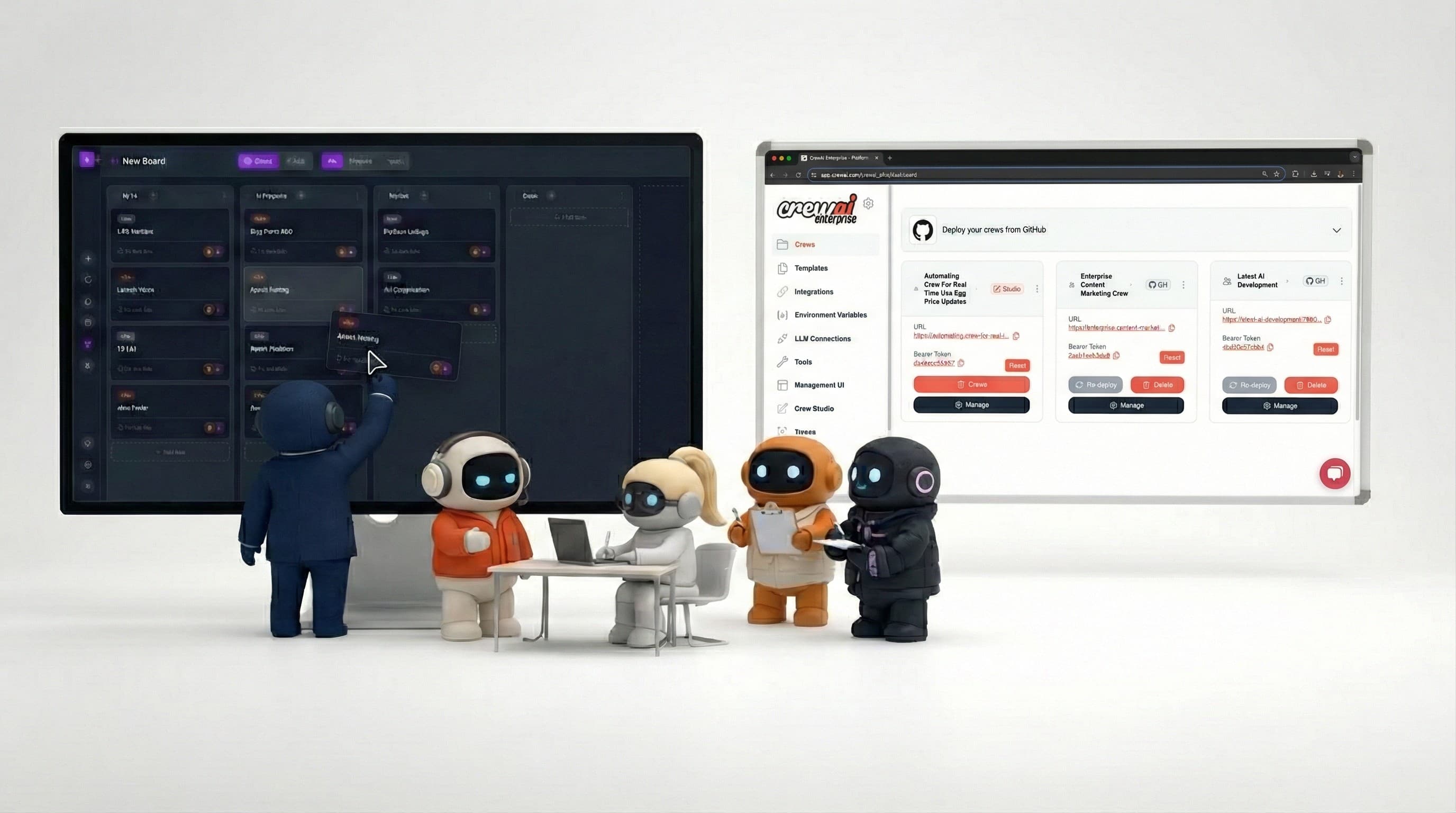

CrewAI is an excellent open-source framework for developers building multi-agent systems in code. It is not a product, and that distinction decides whether it fits you. If you have engineers who want to build and host custom agents, CrewAI is a strong foundation. If you are a business team that needs AI employees working this week, a ready-to-use platform gets you there faster.
Key takeaway: Choose CrewAI if you are building an AI system and have engineering time to invest. Choose a platform like Agently if you want AI employees with a UI, pre-built integrations, and a shared company brain, without writing or maintaining code.
CrewAI is one of the most popular open-source frameworks for building multi-agent AI systems. It lets developers create "crews" of AI agents, each with defined roles, goals, and tools, that collaborate on complex tasks. It's well-designed, actively maintained, and has a growing community.
But CrewAI is a framework, not a product. The difference matters.
A framework gives you building blocks. A product gives you a working solution. If you're a developer who wants to build custom AI agent systems, CrewAI is excellent. If you're a business team that needs AI employees working this week, a framework is the wrong starting point.
This article is for teams evaluating whether CrewAI is the right approach, or whether a ready-to-use platform fits their needs better.
What CrewAI Does Well
Clean, well-designed architecture
CrewAI's core abstraction, Agents, Tasks, Tools, Crews, and Flows, is elegant. Each agent has a role, a goal, and a backstory. Tasks are assigned to agents with clear expectations. Crews orchestrate how agents work together. It's intuitive for developers and produces readable, maintainable code.
Multi-agent collaboration
CrewAI's defining feature is how agents work together. Agents can delegate tasks to each other, share context, and collaborate through sequential or hierarchical processes. A research agent can pass findings to a writing agent, which can pass drafts to an editing agent. This orchestration is the hard problem CrewAI solves well.
LLM flexibility
CrewAI isn't locked to one AI provider. You can use OpenAI, Anthropic, open-source models, or any LLM with a compatible interface. This flexibility matters for teams with specific model preferences, cost constraints, or data privacy requirements.
Open source and extensible
CrewAI is open source (MIT license), free to use, and extensible. You can inspect the code, modify behavior, add custom tools, and contribute improvements. No vendor lock-in, no usage limits, no surprise pricing changes. For developers, this independence is a significant advantage.
Production-oriented
Unlike some AI agent experiments, CrewAI is built for production. It includes memory systems, observability integrations (Langfuse, MLflow, OpenLIT, Portkey), error handling, iteration limits, and tool grounding. These features reflect real engineering discipline, not just a demo.
Growing ecosystem
CrewAI integrates with MCP (Model Context Protocol), supports multimodal agents, and has a growing library of tools and community contributions. The ecosystem is active and expanding.
Where CrewAI Falls Short for Business Teams
It requires developers
CrewAI is a Python framework. Using it means writing Python code, defining agents, configuring tools, writing task descriptions, setting up crews, handling errors, and deploying the system. If your team doesn't have a developer, CrewAI isn't accessible.
Even for teams with developers, building agents with CrewAI is a development project with all that entails: scoping, building, testing, debugging, deploying, and maintaining. It competes for engineering time against your product roadmap.
No user interface
CrewAI doesn't come with a UI. There's no chat interface for team members to interact with agents. No dashboard to see what agents are doing. No workspace where non-technical team members can collaborate with AI. You build the interface yourself, or agents run as backend processes.
For a sales rep who wants to ask an AI to research a prospect, or a marketing manager who wants AI to draft a content calendar, a Python framework with no UI isn't a starting point, it's a dependency on the engineering team.
No built-in integrations
CrewAI provides the framework for building tools, but it doesn't come with pre-built connections to Gmail, Google Calendar, LinkedIn, Twitter, or other business tools. You build or find those integrations yourself. Sending an email through Gmail requires writing the Gmail API integration. Scheduling a meeting requires building the calendar tool.
Each integration is a mini development project. A platform with pre-built OAuth integrations handles this in a few clicks.
Infrastructure is your responsibility
Deploying CrewAI means managing your own infrastructure, servers, scaling, monitoring, error handling, uptime. For a team that wants AI employees helping with daily work, managing infrastructure is overhead that's unrelated to their actual goal.
No shared knowledge base (out of the box)
CrewAI has memory capabilities, but building a knowledge base that your agents reference, uploading company documents, brand guidelines, customer data, requires custom development. There's no built-in "Brain" that you populate through a UI and that agents automatically search.
Maintenance burden
When you build custom agents, you maintain custom agents. When an API changes, your integration breaks. When you need a new capability, you build it. When an agent behaves unexpectedly, you debug it. This is normal for software development, but it's overhead that platform users don't carry.
CrewAI vs. Agently: The Framework vs. Platform Comparison
| Feature | CrewAI | Agently |
|---|---|---|
| What it is | Open-source Python framework | Ready-to-use AI employee platform |
| Who uses it | Developers | Business teams (no code required) |
| Setup time | Days to weeks (development project) | Minutes (sign up, connect tools, chat) |
| User interface | None (build your own) | Full workspace UI, chat, boards, docs, channels |
| Pre-built agents | None (define your own) | Jarvis orchestrator + specialist sub-agents (sales, ops, marketing, support, research) |
| Integrations | Build your own | Pre-built, Gmail, Outlook, Calendar, Notion, LinkedIn, Twitter/X |
| Knowledge base | Custom development required | Built-in Brain (upload docs, snippets, web pages) |
| Task management | None | A built-in task queue (Work) |
| Document editor | None | Built-in (Pages) |
| Team collaboration | None | One shared task queue for agents and teammates |
| LLM flexibility | Any LLM provider | Platform-managed models (Fast + Smart modes) |
| Cost | Free (open source) + infrastructure + dev time | Free tier; subscription plans |
| Customization | Unlimited (you build everything) | Customize through Brain and conversation |
| Infrastructure | Self-managed | Managed by platform |
| Multi-agent collaboration | Core feature, agents delegate and collaborate | Agents share workspace context |
| Best for | Developers building custom AI systems | Teams wanting ready-to-use AI employees |
Who Should Use CrewAI
CrewAI is the right choice if:
-
You're building an AI product. If AI agents are part of what you're building (not just what you're using), CrewAI is a solid foundation. It's a development tool, and it's best when used as one.
-
You have engineering resources to dedicate. If a developer (or team) can commit to building, testing, and maintaining agent systems, CrewAI rewards that investment with flexibility and control.
-
You need maximum customization. If your agent requirements are highly specific, proprietary workflows, custom models, unique tool chains, building from a framework gives you control that no platform offers.
-
You want to avoid vendor lock-in. Open source means no vendor dependencies, no pricing surprises, and no platform risk. You own the code and the infrastructure.
-
You want to learn how AI agents work. If understanding multi-agent systems at a technical level is valuable to you (personally or strategically), CrewAI is one of the best ways to learn.
-
You need specific LLM choices. If you must use a particular model (for cost, privacy, or capability reasons), CrewAI's LLM flexibility supports that.
Who Should Consider a Platform Instead
A ready-to-use platform fits better when:
-
Your team doesn't have dedicated developers. If the people who need AI agents are sales reps, marketers, operations leads, and customer success managers, not engineers, a platform with a UI is the accessible option.
-
Speed to value matters. If you need AI helping with real work this week, not after a development sprint, pre-built agents with pre-built integrations get you there faster.
-
You want to use AI, not build AI. The goal is better sales outreach, faster content creation, and more efficient operations, not building a multi-agent system. The AI is a means to an end, not the end itself.
-
Infrastructure isn't your business. If managing servers, handling deployments, and ensuring uptime isn't what you want to spend time on, a managed platform handles that.
-
Your needs are standard business functions. Sales, marketing, operations, customer support, research, these are well-understood domains that pre-built agents handle without custom development.
-
Total cost of ownership matters. CrewAI is free, but developer time, infrastructure, and maintenance aren't. For a small team, a $X/month platform subscription is often cheaper than the loaded cost of engineering hours building and maintaining custom agents.
A Middle Ground
Some teams take a hybrid approach:
-
Use a platform like Agently for immediate business needs, sales outreach, content creation, email management, customer communication. Get value today.
-
Use CrewAI for custom automation projects that require specific logic your platform can't handle. Invest engineering time where it creates unique competitive advantage.
This isn't unusual. You don't have to choose one approach for everything. Use the platform for standard workflows and the framework for specialized ones.
Other Alternatives Worth Considering
LangGraph , If you want a framework (not a platform), LangGraph is another option for building AI agent workflows. More closely tied to the LangChain ecosystem.
Lindy AI , A no-code agent builder that sits between CrewAI's framework approach and Agently's ready-to-use approach. You design workflows visually, without code, but still configure from scratch.
Relevance AI , Another agent builder platform with enterprise features. More powerful than Lindy, but with similar builder overhead. Good for technical teams that want a platform rather than a framework.
The Bottom Line
CrewAI is an excellent engineering tool. Agently (and similar platforms) are business tools. They serve different audiences solving different problems:
If your question is "how do I build a multi-agent AI system?", CrewAI is a great answer.
If your question is "how do I get AI helping my team with sales, marketing, and operations?", a platform is the faster, more practical path.
The right choice depends on whether you have engineers or operators asking the question.