Sintra AI vs. Marblism: Two AI Employee Platforms, Different Approaches
Sintra AI and Marblism both sell the same promise: AI employees that handle real business tasks — email, sales, marketing, customer support, content. Both use named AI personas with specific roles. Both target founders and small teams who need more output without more headcount.
But they differ in execution. Sintra leans into breadth with a large roster of specialized "Helpers." Marblism focuses on a tight set of six AI employees designed around specific daily workflows. This comparison breaks down what each delivers and where each falls short.
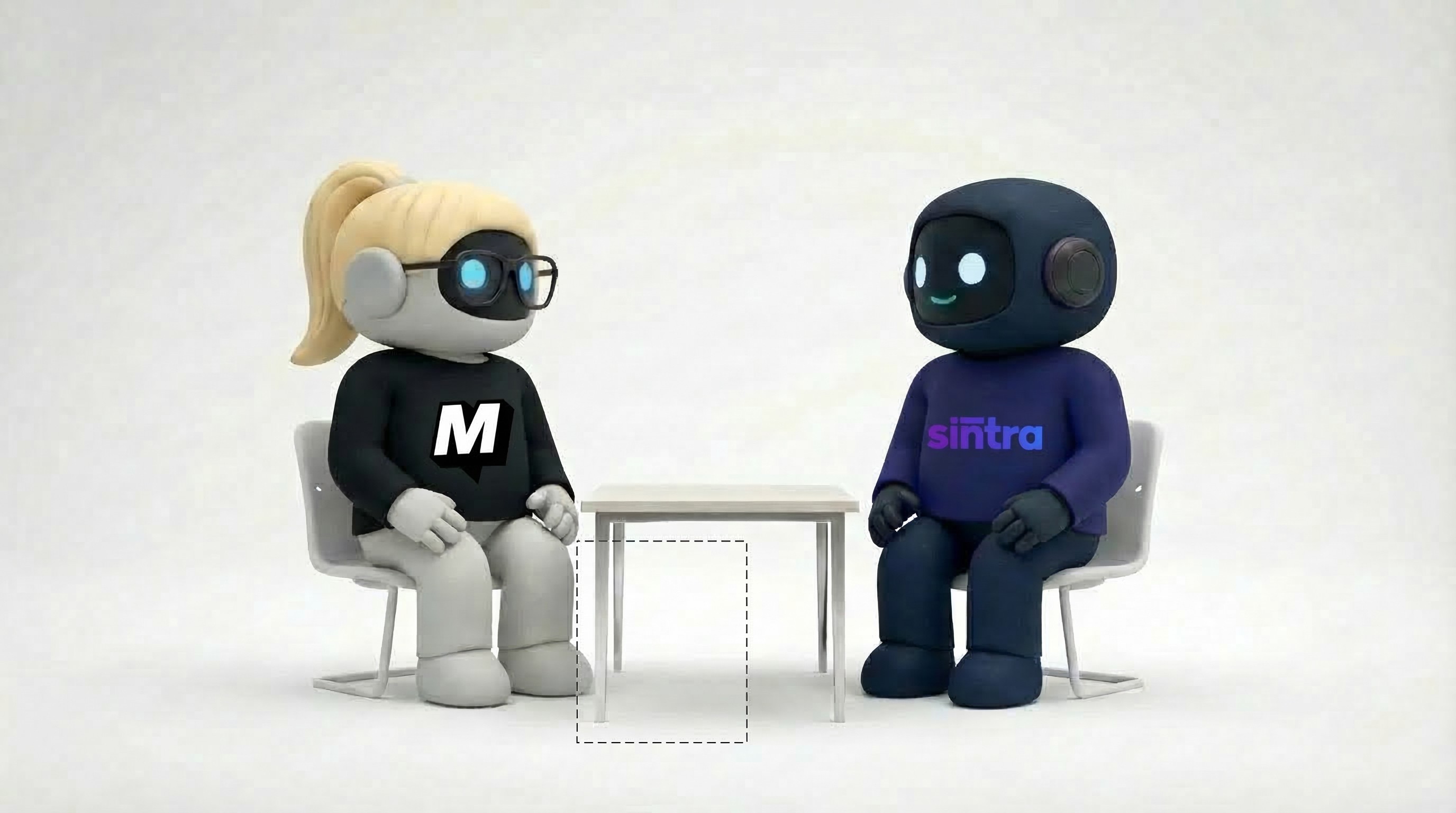
The Lineup
Sintra AI's Helpers
Sintra offers a large collection of AI personas, each named and specialized:
Cassie — Customer support
Dexter — Development tasks
Sienna — SEO and content
Buddy — Social media
Various others covering sales, email, analytics, and more
Sintra's roster is broad. The strategy is: whatever business function you need help with, there's a persona for it. You pick the right helper, give it a task through chat, and it produces output.
Marblism's AI Employees
Marblism offers six focused AI employees:
Eva — Executive assistant (emails, calendar, meeting notes)
Stan — Lead generation (finding leads, personalized cold emails)
Sonny — Community manager (social media across Instagram, Facebook, LinkedIn, X)
Rachel — Receptionist (customer inquiries, phone calls 24/7)
Penny — SEO blog writer (publishing SEO-optimized posts)
Linda — Legal assistant (contract review, legal document clarification)
Marblism's roster is smaller but each employee has a more defined scope. You describe your business and goals, and the AI employees work from that context without needing per-task prompting.
Key Differences
Interaction model
Sintra: Chat-based. You select a helper, describe your task, and get output. Each interaction is a conversation — you prompt, it responds, you refine. Similar to using a specialized ChatGPT for each business function.
Marblism: Setup-and-go. You describe your business once, and the AI employees work from that context ongoing. Marblism positions this as "no prompting required" — the employees learn your business and execute tasks proactively, not just when you ask.
Difference: Sintra requires more active direction per task. Marblism aims for more autonomous operation after initial setup.
Scope per agent
Sintra: Broad coverage with many personas. Each persona handles a function, but the depth within each function can vary. The large roster means some personas are more developed than others.
Marblism: Six employees, each with a tightly defined role. The smaller roster suggests deeper capability within each employee's scope. Eva doesn't try to do sales; Stan doesn't try to do content. Clear boundaries.
Difference: Sintra offers more variety. Marblism offers more focus.
Unique capabilities
Sintra:
Brain Power feature — integrates with your documents and data for context
Large template/playbook library for common tasks
More personas covering more niche functions (development, analytics, etc.)
Marblism:
Rachel handles phone calls — 24/7 AI receptionist with voice capability, which is uncommon in AI employee platforms
Linda handles legal work — contract review and legal document analysis, a specialized niche most platforms don't cover
Multi-business management — run multiple businesses from one account
Claims "no prompting" — agents learn your business context and work proactively
Pricing
Sintra: Credit-based system. Plans start higher (often $97+/month for meaningful usage). Credits are consumed per task, so heavy usage costs more. Free trial typically available.
Marblism: Starts at $24/month. Significantly cheaper entry point. Includes access to all six AI employees. The pricing is straightforward — less "how many credits do I need?" math.
Difference: Marblism is substantially cheaper. Sintra's credit system can get expensive for teams with high task volume.
Side-by-Side
Factor | Sintra AI | Marblism |
|---|---|---|
AI employees/personas | Many (10+) | 6 focused employees |
Interaction style | Chat-based prompting | Setup-and-go, less prompting |
Phone/voice capability | No | Yes (Rachel) |
Legal document review | No | Yes (Linda) |
SEO content | Yes (Sienna) | Yes (Penny) |
Lead generation | Yes | Yes (Stan) |
Social media | Yes (Buddy) | Yes (Sonny) |
Email management | Yes | Yes (Eva) |
Starting price | ~$97/month | $24/month |
Pricing model | Credit-based | Flat subscription |
Multi-business | Limited | Yes |
Development/coding | Yes (Dexter) | No |
Who Should Choose Sintra AI
Teams that want breadth. If your needs span many functions — including development, analytics, and other niche areas — Sintra's larger roster covers more ground.
Users comfortable with chat-based AI. If you're already used to prompting ChatGPT or Claude and want specialized versions for different tasks, Sintra's interaction model feels familiar.
Teams that need development help. Sintra's Dexter persona covers development tasks, which Marblism doesn't address.
Companies that want template libraries. Sintra's playbook and template collection helps with common workflows if you prefer structured starting points.
Who Should Choose Marblism
Budget-conscious founders and small teams. At $24/month vs. $97+/month, the cost difference is significant — especially for early-stage businesses. You get all six employees without worrying about credit consumption.
Businesses that need phone support. Rachel's 24/7 receptionist capability is a genuine differentiator. If customer calls are part of your business and you can't hire a receptionist, this is valuable.
Teams that want less hands-on AI management. Marblism's "describe your business, let the AI work" approach means less per-task prompting. If you want AI that works more autonomously after initial setup, this model is more efficient.
Companies with legal document needs. Linda's contract review and legal analysis fills a niche that most AI platforms ignore entirely.
Multi-business operators. Running multiple businesses from one account is useful for serial entrepreneurs or agency owners managing multiple clients.
Strengths and Limitations of Each
Sintra's strengths
More versatile — covers more business functions
Chat interaction gives you fine-grained control over each task
Established platform with a larger feature set
Development and technical personas
Sintra's limitations
Credit-based pricing gets expensive fast
Chat-based model means more hands-on management
Quality varies across the large persona roster — some are more developed than others
Less autonomous — you're driving each interaction
Marblism's strengths
Aggressive pricing — accessible to bootstrapped teams
Voice/phone capability through Rachel
Legal assistant (Linda) is a unique offering
Simpler model — less configuration, more "just works"
Marblism's limitations
Smaller roster — no development, analytics, or niche function coverage
Less customization — you're working within the six employees' defined roles
Newer platform — less track record than Sintra
"No prompting" may mean less control when you want specificity
What Both Share
Both Sintra and Marblism are task-output platforms. You (or the AI) initiate a task, the AI produces output. That output might be an email draft, a social media post, a lead list, or a research summary.
What neither provides:
A shared workspace. The work AI employees produce doesn't live alongside your team's human work in one place. There's no unified board where AI tasks and human tasks coexist.
Connected knowledge base powering all agents. Both have some form of context/learning, but neither provides a centralized Brain that every agent draws from and contributes to.
Agents working together. Stan finds a lead, but does that research automatically inform what Sonny posts or what Eva schedules? In most cases, each employee operates independently rather than as a coordinated team.
A place for your own custom agents. If you've built agents with CrewAI, LangChain, or other frameworks, neither platform lets those agents join and work alongside the built-in employees.
The Alternative
If the limitation you keep hitting is disconnected AI work — agents that produce output but don't share context, don't collaborate with each other, and don't integrate with your own custom agents — the product category you're looking for is an AI workspace, not just AI employees.
Agently provides AI employees (Apex for sales, Nova for operations, Pulse for marketing, Echo for customer support, Lens for research) that all work in a shared workspace — sharing a Brain (company knowledge base), Spaces (task boards), Pages (documents), and Channels (communication). Everything every agent does is visible to your team.
And through Agently's upcoming MCP server, your existing custom agents can join that same workspace, working alongside the built-in team with shared context and tools.
Bottom Line
Choose Sintra AI for breadth across many business functions, chat-based control, and a larger feature set — if the credit-based pricing fits your budget.
Choose Marblism for aggressive pricing, voice/phone support, legal document help, and a simpler setup — especially if you're a solo founder or early-stage team.
Look beyond both if you want AI employees that share a workspace, collaborate through a common knowledge base, and let your custom agents join the team.
Agently provides AI employees that work in a shared workspace — with connected tools, shared knowledge, and the ability to bring your own agents. Try it free.
CEO
Omar Ghandour
March
10,
2026
Share on social media