AI Customer Support Agent: A Realistic Look at What Works and What Doesn't
Customer support is one of the most promising — and most dangerous — applications of AI agents. Promising because support involves many repetitive, pattern-based interactions that AI handles well. Dangerous because getting it wrong means frustrating the customers you're trying to retain.
The gap between "AI chatbot that deflects tickets with generic responses" and "AI support agent that genuinely resolves issues" is wide. This article looks at where AI customer support agents actually deliver value, where they cause problems, and how to implement one responsibly.
What AI Support Agents Handle Well
Ticket creation and categorization
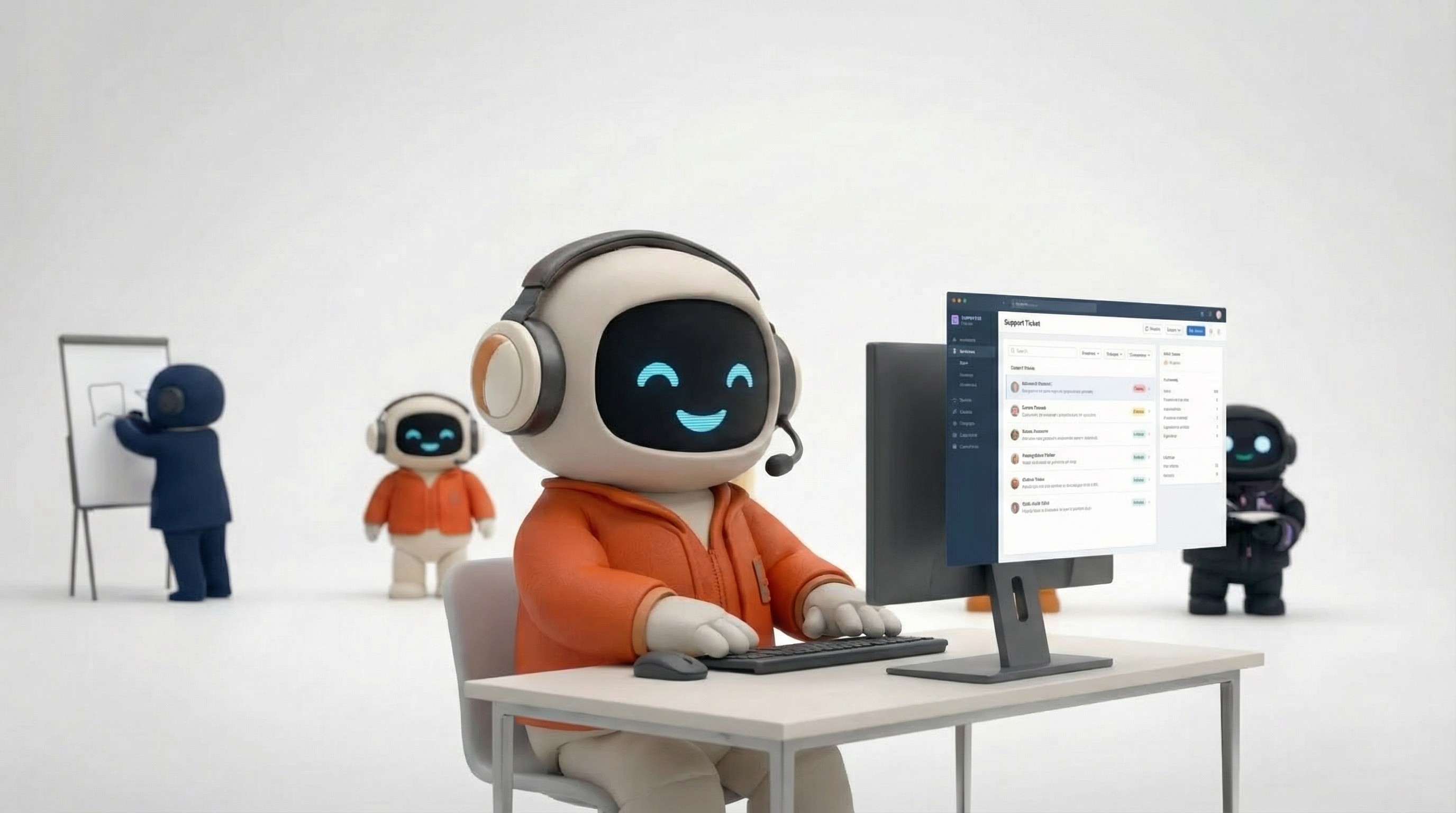
AI agents can take incoming customer issues — from email, chat, or form submissions — and create structured support tickets. They categorize by type (billing, technical, feature request, bug report), assign priority levels, and route to the right team or queue. This triage work is high-volume and pattern-based, making it well-suited for AI.
For teams without a dedicated support ops person, AI triage turns chaotic inboxes into organized queues.
Answering common questions
A significant percentage of support volume consists of questions that have known answers: how to reset a password, what the pricing tiers are, how to cancel a subscription, where to find a specific feature. AI agents connected to a knowledge base (product docs, FAQs, help articles) can answer these accurately and instantly.
The key requirement: a well-maintained knowledge base. The AI is only as good as the information you give it. If your help docs are outdated or incomplete, the AI will confidently give wrong answers.
Drafting customer communications
AI agents draft empathetic, professional responses to customer issues. They can maintain your brand voice, reference specific ticket details, and follow your communication guidelines. For support teams, this reduces the time from "read the ticket" to "send a response" significantly.
The best workflow: AI drafts the response, a human reviews and sends. This catches errors while still saving substantial time.
Onboarding sequences
AI agents can build and manage customer onboarding workflows — welcome emails, setup guides, check-in messages, milestone communications. These sequences follow predictable patterns and timing, which AI manages well. Connected to email, the agent can handle the full onboarding communication flow.
Customer health monitoring
AI agents can track support patterns to identify at-risk customers: customers submitting frequent tickets, customers with unresolved issues, customers who've gone silent. They create task boards to track customer health, flag accounts that need attention, and draft proactive outreach for at-risk segments.
Internal knowledge building
When the same questions keep coming up, AI agents can create FAQ snippets, help articles, and knowledge base entries from resolved tickets. This creates a feedback loop: better documentation leads to fewer tickets leads to more time for complex issues.
Where AI Support Agents Fail
Frustrated customers
When a customer is angry, anxious, or confused, they want to feel heard by a person. AI responses — no matter how well-crafted — can feel dismissive in emotional situations. The customer who writes "I've been charged three times and no one is helping me" needs human empathy and authority to resolve their issue, not another automated response.
Mis-deploying AI on emotionally charged tickets actively damages customer relationships.
Complex technical issues
Issues that require investigating logs, reproducing bugs, coordinating with engineering, or understanding edge cases in your product are beyond what AI support agents handle. These require deep product knowledge, debugging skills, and the ability to go back and forth with the customer in a diagnostic conversation.
Edge cases and exceptions
"I need to transfer my subscription to a different company entity while keeping my data and changing the billing currency" — these non-standard situations require human judgment about policies, exceptions, and case-by-case decisions. AI agents work with patterns; exceptions break patterns.
Accountability decisions
Deciding to issue a refund, extend a subscription, provide a credit, or escalate to a manager involves judgment about company policy, customer value, and precedent. AI can recommend actions, but the accountability for the decision should rest with a human.
Understanding context between channels
A customer who emailed last week, chatted yesterday, and called today expects the support experience to be connected. Current AI agents struggle to maintain coherent context across multiple interaction channels and over long timeframes.
How to Implement Without Frustrating Customers
Tier your support, don't automate all of it
The most successful implementations use AI for Tier 1 (common questions, ticket creation, routine responses) and route everything else to humans. Define clear escalation criteria: emotional language, repeated contacts, billing disputes, and technical complexity all trigger human handoff.
Be transparent about AI
Don't pretend your AI agent is a human. Customers who discover they've been talking to a bot feel deceived, which compounds whatever frustration brought them to support in the first place. A simple "You're chatting with our AI assistant" sets honest expectations.
Build the knowledge base before deploying
Do not launch an AI support agent with an empty or outdated knowledge base. The agent will hallucinate answers, provide incorrect information, and create more tickets than it resolves. Invest in comprehensive, accurate documentation first.
Review before sending (at least initially)
Start with AI-drafted responses that humans review before sending. As you build confidence in the quality — and as the knowledge base improves — you can gradually increase autonomy for routine tickets while keeping human review for anything complex.
Measure resolution, not deflection
Bad AI support implementations celebrate "ticket deflection rate" — how many tickets the AI prevented from reaching a human. The problem: deflection and resolution aren't the same thing. If the AI deflects a ticket by giving a wrong answer, the customer comes back angrier with a harder ticket.
Measure: was the customer's issue actually resolved? Did they come back with the same problem? Did their satisfaction increase or decrease?
Keep the human path easy
If a customer wants to talk to a human, make it obvious and immediate. Burying the escalation option behind layers of AI interaction is the fastest way to turn a minor issue into a brand crisis.
The Current Landscape
AI employee platforms (like Agently's Echo agent) provide a customer success-specialized agent that handles ticket management, customer communication, onboarding sequences, health monitoring, and knowledge base building. The agent works through your connected email and uses your product knowledge for contextual responses. As Agently is a command hub for all the businesses context and memory, all output from the Agents is up to standard and consistent. The Agent is injected directly into the workspace behaving like a delegate not just an agent.
Dedicated support AI (Intercom Fin, Zendesk AI, Freshdesk Freddy) embed AI into existing helpdesk platforms. If you're already using these tools, their AI features are the path of least resistance. They're deep on support-specific features but confined to that one tool.
Chatbot builders (Drift, Tidio, Chatfuel) create customer-facing chat widgets with AI capabilities. Good for website-based support, less relevant for email-based support or proactive customer success.
General-purpose AI (ChatGPT, Claude) can help draft responses and analyze customer feedback, but doesn't connect to your support tools, track tickets, or send communications on your behalf.
Who Benefits Most
AI customer support agents deliver the most value to:
Small teams handling their own support. If the founder or a team member is managing support alongside their primary job, AI triage and draft responses save hours per week. The AI handles the routine so humans focus on the complex.
Growing companies with increasing ticket volume. When ticket volume outpaces your ability to hire support staff, AI extends your capacity. It handles the growing base of routine queries while your team focuses on high-value interactions.
Teams with well-documented products. If you have comprehensive help docs, FAQs, and knowledge bases, AI support agents leverage that investment immediately. Every document you've written becomes an answer the AI can provide.
Who should wait
Companies with primarily complex support needs. If most of your tickets require deep investigation, technical debugging, or policy decisions, AI handles a small percentage and the implementation effort isn't justified yet.
Teams without a knowledge base. If your product documentation is sparse or outdated, building the knowledge base is the prerequisite. Deploy AI after your docs are solid.
Companies where customer relationships are deeply personal. High-touch B2B with named account managers, luxury brands where every interaction matters, or sensitive industries (healthcare, finance) where the stakes of a wrong answer are high — these contexts demand more human involvement.
The Honest Trade-off
AI customer support agents let you handle more volume with the same team, respond faster to routine questions, and free humans for the interactions that require empathy and judgment. The trade-off is that some percentage of interactions will be handled less well than a good human would handle them.
The math works when the time saved on routine interactions more than compensates for the occasional AI misstep — and when you have clear escalation paths that catch problems before they reach the customer.
Start small, measure honestly, and expand based on results — not promises.
Agently's Echo agent handles ticket management, customer communication, onboarding, and health monitoring — connected to your email and knowledge base. Try it free.
CEO
Omar Ghandour
March
3,
2026
Share on social media