AI Research Assistant: How AI Changes the Way Teams Gather and Use Intelligence
Research is the foundation of good decisions. Before you enter a market, approach a prospect, launch a product, or hire a competitor's employee, you research. But research is also one of the most time-consuming activities in business — hours of reading, cross-referencing, synthesizing, and structuring information into something actionable.
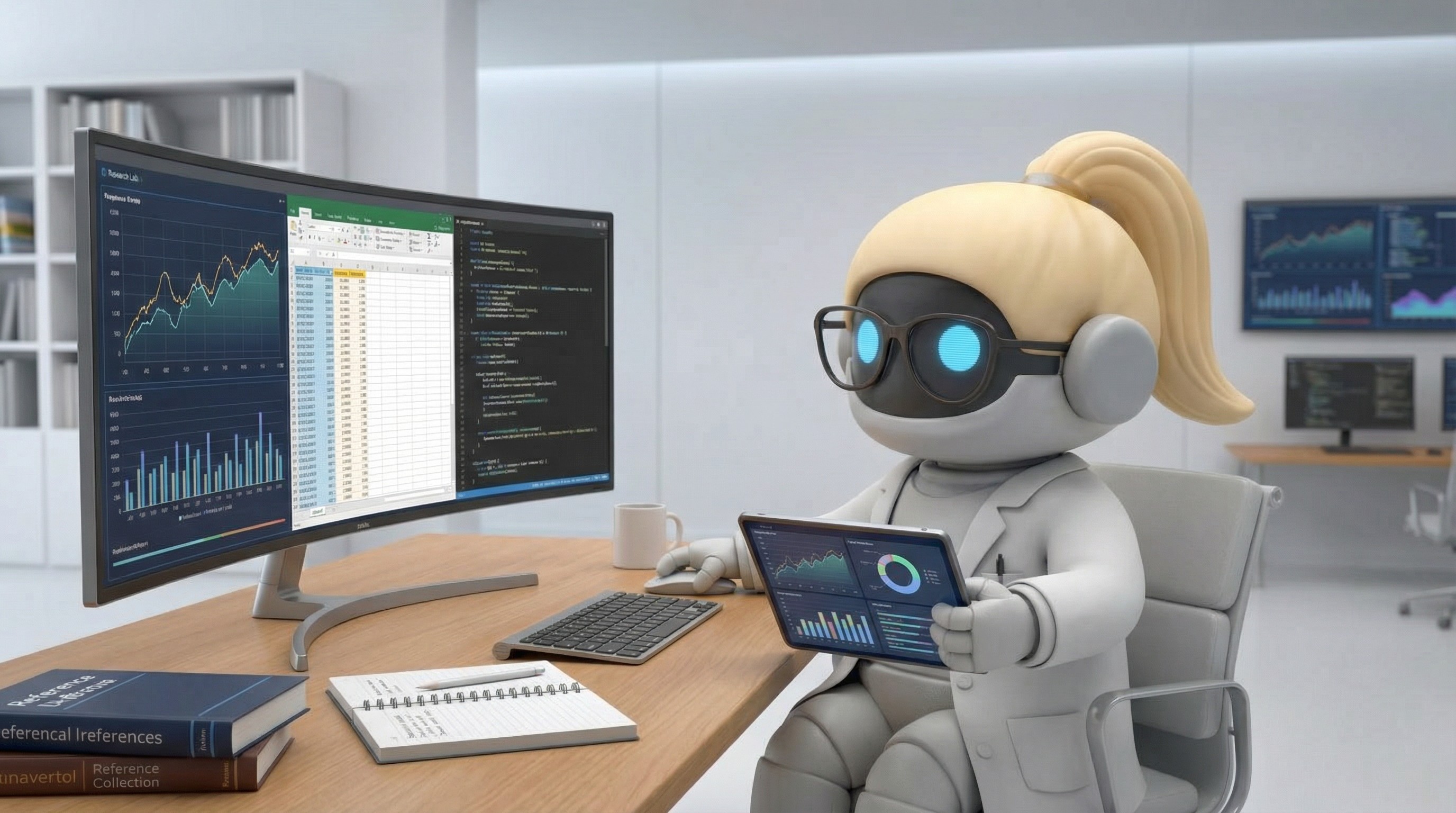
AI research assistants compress that timeline. They search the web, read pages, cross-reference sources, and synthesize findings into structured reports. What took a junior analyst a full day, an AI research assistant produces in a conversation.
The question, as always, is where the output is genuinely useful and where it falls short.
What AI Research Assistants Do Well
Competitive analysis
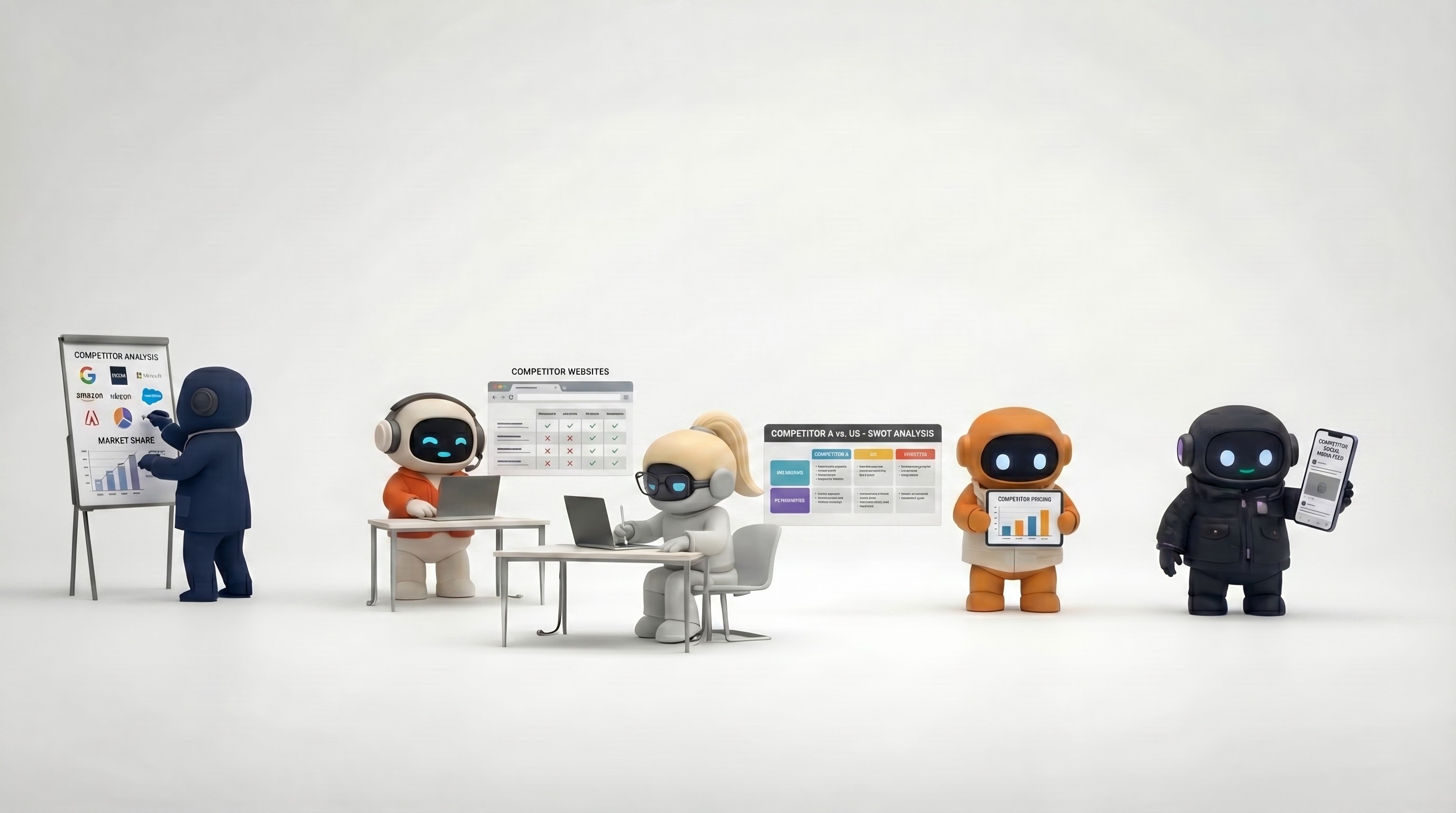
Give an AI research assistant a list of competitors, and it'll research each one: their products, pricing, positioning, recent news, key hires, funding history, strengths, and weaknesses. It produces comparison matrices, identifies gaps you can exploit, and highlights threats worth monitoring.
For teams that should do competitive analysis regularly but never find the time, AI makes it feasible. A quarterly competitive review that would take days of manual research becomes a 30-minute conversation.
Market research and sizing
AI assistants can research market size (TAM/SAM/SOM), growth trends, key players, market dynamics, and barriers to entry. They search for industry reports, news articles, and public data, then synthesize findings into structured assessments.
The output isn't investment-bank-grade research with proprietary data. It's a solid directional analysis based on publicly available information — sufficient for most business decisions that don't require exact numbers.
Prospect and company research
Before a sales meeting, partnership discussion, or investment decision, AI research assistants compile comprehensive company profiles: what the company does, their recent news, key people, financial situation (if public), competitive position, and relevant background. These pre-meeting briefs combine web research with your internal knowledge base for a complete picture.
Industry trend analysis
AI assistants scan the web for emerging trends, shifting customer behaviors, new technologies, and regulatory changes in your industry. They identify patterns across multiple sources and present a synthesized view of where things are heading.
SWOT and strategic frameworks
Ask an AI research assistant for a SWOT analysis, Porter's Five Forces, or a go-to-market framework, and it'll produce one grounded in actual research about your market — not generic templates. The combination of research capability and analytical frameworks is where AI research assistants differentiate from simple web search.
Data synthesis across sources
The most valuable capability: taking large volumes of information from multiple sources and distilling it into actionable takeaways. Read 15 articles about a market, cross-reference them, identify consensus views and outliers, and present the synthesis in a structured format. This is tedious for humans and natural for AI.
Where They Fall Short
Proprietary data and primary research
AI research assistants work with publicly available information. They can't access paid research databases (Gartner, Forrester, CB Insights), conduct customer interviews, run surveys, or analyze your internal data. If your research question requires proprietary data or primary research, AI handles only part of the job.
Recency and accuracy
AI assistants search the web, but web information can be outdated, inaccurate, or biased. Company websites may not reflect recent changes. News articles may contain errors. Market size estimates vary wildly between sources. The AI synthesizes what it finds, but it can't verify accuracy better than the sources allow.
Always validate critical numbers and claims. AI research is directional, not definitive.
Deep domain expertise
Researching a general market or competitor is well within AI capabilities. Analyzing the regulatory implications of a pharmaceutical compound, evaluating the technical architecture of a competitor's software, or assessing the legal risks of a market entry strategy requires domain expertise that general-purpose AI doesn't possess.
For deep domain research, specialized AI tools or human experts are better suited.
Original insight and interpretation
AI research assistants are excellent at gathering, organizing, and summarizing information. They're less effective at generating original insights — the "so what does this mean for us specifically" interpretation that turns research into strategy.
The research is the input; the strategic judgment is still human work. AI accelerates the input gathering so you spend more time on the interpretation.
Confidential and sensitive research
Researching a potential acquisition target, investigating a competitor's vulnerabilities, or analyzing a market you plan to disrupt — these sensitive research tasks carry risks if the queries or outputs are visible to the AI provider. Consider data privacy implications for research involving confidential strategic decisions.
How to Get the Most From AI Research
Be specific in your requests
"Research the market" produces generic output. "Research the market for AI-powered customer support tools in North America, focusing on companies with 50-500 employees, including market size, top 5 competitors, pricing models, and key buying criteria" produces useful output. The more specific your research brief, the more targeted the results.
Use your knowledge base
AI research assistants that draw from your internal knowledge base produce dramatically better output. When the AI knows your product, your positioning, your target market, and your competitive advantages, it can evaluate research findings through the lens of your specific business — not just summarize what it finds.
Request structured output
Ask for comparison tables, bullet-point summaries, SWOT matrices, and prioritized lists. Structured formats are easier to act on than long narrative reports. They're also easier to share with your team and reference later.
Create research as documents
The best AI research assistants save output as documents or pages you can reference, share, and build on. Research that lives in a chat conversation is hard to find later. Research saved as a structured document in your workspace becomes a lasting asset.
Build a research cadence
The real value of AI research isn't one-off projects — it's establishing a regular research rhythm that wasn't feasible before. Monthly competitive reviews, quarterly market analysis, weekly industry trend scans. AI makes recurring research sustainable for small teams.
The Current Landscape
AI employee platforms (like Agently's Lens agent) provide a research-specialized agent with web search, URL reading, knowledge base access, and document creation tools. The agent conducts multi-source research and produces structured reports saved as workspace documents. As Agently is a command hub for all the businesses context and memory, all output from the Agents is up to standard and consistent. The Agent is injected directly into the workspace behaving like a delegate not just an agent.
Research-focused AI (Perplexity, Elicit, Consensus) specialize in research with source citation, reduced hallucination, and academic rigor. Excellent for factual research and literature review, but don't connect to your business tools or knowledge base.
General-purpose AI (ChatGPT with browsing, Claude with search) conduct web research within conversations. Strong reasoning and synthesis, but no business context, no document saving, and no integration with your workspace.
Business intelligence tools (Crayon, Klue, Similarweb) provide ongoing competitive monitoring with dashboards and alerts. More automated and data-driven than conversational AI research, but narrower in scope and more expensive.
Who Benefits Most
Founders making strategic decisions. Market entry, pricing, competitive positioning, partnership evaluation — these decisions benefit from research that founders often skip because of time constraints. AI makes the research feasible.
Small teams without a research function. Companies with 5-20 people rarely have a dedicated analyst. AI fills that gap, providing research capability that would otherwise require a hire or a consulting engagement.
Sales teams preparing for meetings. Pre-meeting research dramatically improves sales conversations. AI makes it practical to research every prospect, not just the big ones.
Marketing teams planning content and positioning. Understanding what competitors are publishing, what topics are trending, and what gaps exist in the market informs better content strategy.
The Honest Assessment
AI research assistants are a genuine productivity multiplier for information gathering and synthesis. They take the most time-consuming part of research — reading, cross-referencing, and organizing information from multiple sources — and compress it from hours to minutes.
They don't replace the human capabilities that make research valuable: asking the right questions, interpreting findings in context, generating original insights, and making strategic decisions. The AI handles the legwork; the human handles the thinking.
For teams that should research more but don't have time, AI research assistants remove the time barrier. The risk isn't that the research will be perfect — it's that you'll accept it uncritically. Review the output, validate key claims, and add your own interpretation. That's where research becomes strategy.
Agently's Lens agent conducts deep research — competitive analysis, market sizing, company profiles, trend synthesis — and saves structured reports to your workspace. Try it free.
CEO
Omar Ghandour
March
3,
2026
Share on social media