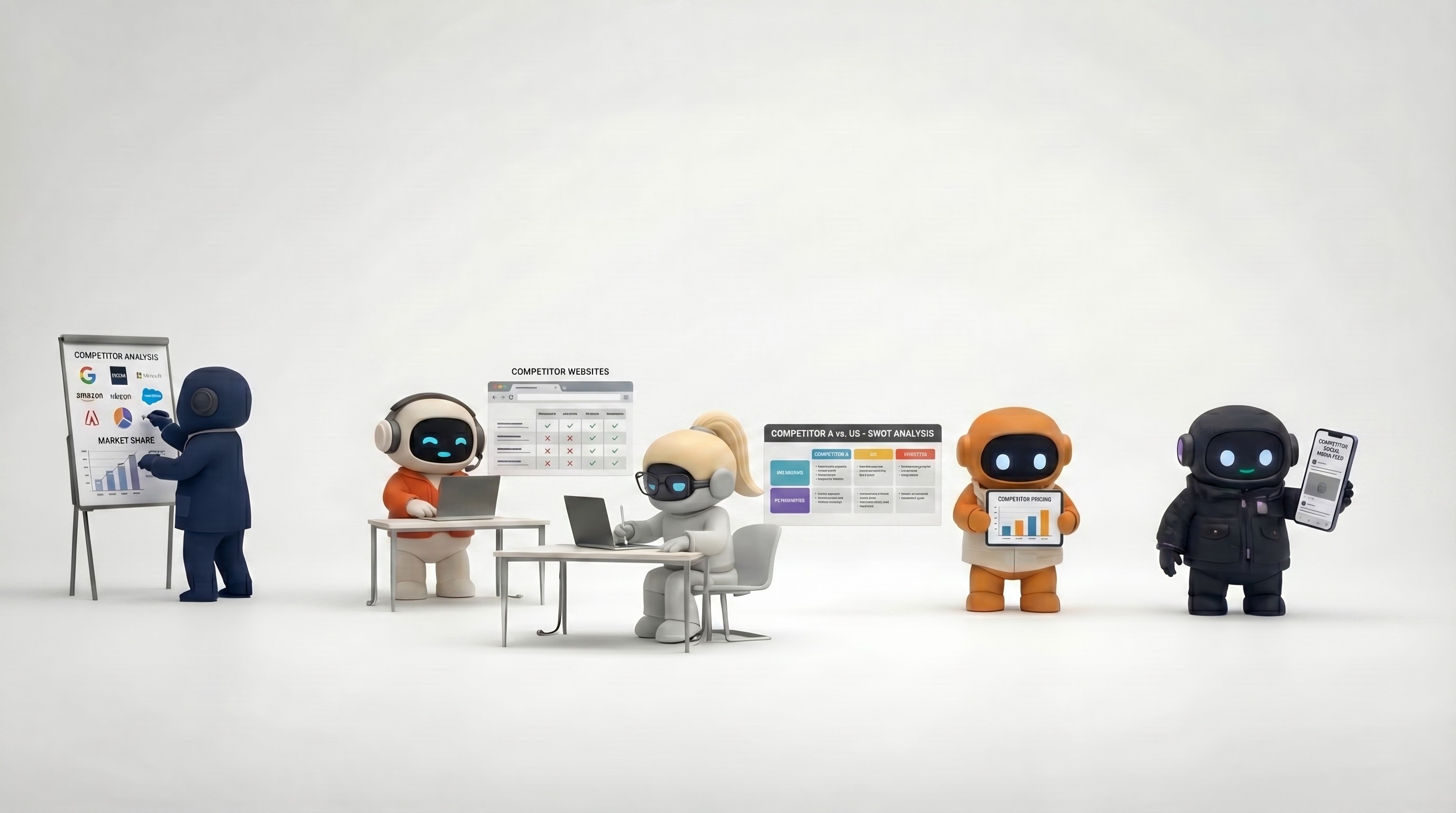
AI Employees vs. Freelancers: Which Makes Sense for Your Business
When your team is stretched thin but a full-time hire doesn't make sense, two options emerge: hire a freelancer or deploy an AI employee. Both extend your team's capacity without the commitment and cost of a full-time role. But they work differently, cost differently, and suit different types of work.
This comparison examines both options honestly — where each excels, where each falls short, and how to decide which fits your situation.

Cost Comparison
Freelancers
Freelancer costs vary dramatically by skill, geography, and platform:
Virtual assistants (general admin): $5–$25/hour, depending on location and skill
Content writers: $30–$100/hour for quality work, or $0.10–$0.50/word
Marketing specialists: $50–$150/hour
Sales development reps (outsourced): $2,000–$5,000/month for dedicated reps
Research analysts: $40–$100/hour
Hidden costs:
Management overhead. Freelancers need briefs, feedback cycles, and communication. This takes your time — the scarcest resource.
Ramp-up time. Each new freelancer needs to learn your brand, products, customers, and processes. Even good freelancers take 1–2 weeks to produce work that fits your standards.
Quality variability. Some deliverables are excellent, others need heavy revision. You're paying both the freelancer's rate and your revision time.
Platform fees. Upwork charges 5–10%. Agencies take 30–50% margins. These add up.
Typical monthly spend for a small team using freelancers across multiple functions: $2,000–$10,000+/month.
AI employees
AI employee platforms charge flat monthly subscriptions:
Entry tier: $50–$100/month (limited usage)
Standard tier: $100–$300/month (covers most small team needs)
Growth tier: $300–$500/month (higher volume, more features)
No hidden costs:
No management overhead beyond initial setup
No ramp-up — connects to your knowledge base on day one
No quality variability per task (consistent output)
No platform fees
Typical monthly spend: $100–$500/month for coverage across multiple functions.
The math for repetitive tasks
If you pay a freelance VA $15/hour to handle email management, scheduling, and basic research for 4 hours/day:
Freelancer: $15 × 4 hours × 22 working days = $1,320/month
AI employee: $100–$300/month for the same tasks, available 24/7
For content writing — 8 blog posts per month at $200 each:
Freelancer: $1,600/month (plus your review and feedback time)
AI employee: $100–$300/month for first drafts (you still review and refine)
The cost advantage is significant for high-volume, repeatable work. For one-off specialized projects, the comparison shifts.
Turnaround Time
Freelancers
Finding the right person: 1–7 days (posting, screening, interviewing)
Onboarding to your business: 1–2 weeks
Per-task turnaround: Hours to days, depending on freelancer availability, workload, and time zone
Revision cycles: 1–3 rounds for most deliverables
Availability: Their working hours (which may not match yours)
AI employees
Setup: 1–2 hours (connect tools, configure knowledge base)
Per-task turnaround: Minutes to hours
Revision: Immediate — adjust the prompt, get updated output
Availability: 24/7, no time zone issues, no waiting for someone to "get to your task"
For time-sensitive work — a prospect needs a follow-up now, a customer needs a response before end of business, content is due tomorrow — the AI employee's speed is the differentiator.
Quality Comparison
This is the nuanced part.
Where AI employees produce higher quality
Consistency. The 50th email follows your brand voice as precisely as the 1st. A freelancer's quality fluctuates based on workload, attention, fatigue, and how well they remember your guidelines.
Brand alignment. AI employees work from your knowledge base — product details, messaging frameworks, customer personas, brand voice guidelines. Every output is grounded in your specific business context. Freelancers work from briefs, which are only as good as what you write and they remember.
Speed-to-quality ratio. For tasks where "good enough, fast" beats "perfect, slow" — status updates, email responses, social media drafts, meeting summaries — AI employees deliver usable output instantly.
Where freelancers produce higher quality
Creative depth. A skilled writer produces prose with personality, unexpected angles, and narrative craft that AI doesn't match. If your content strategy depends on a distinctive voice, a good freelancer delivers that.
Strategic thinking. A freelance marketing consultant doesn't just write copy — they analyze your positioning, identify gaps, and recommend strategy changes. AI employees execute; they don't consult.
Visual and design work. Graphic design, video editing, brand design, illustration — these are human-craft domains where AI tools assist but don't replace skilled freelancers.
Complex research. A freelance research analyst conducts interviews, synthesizes qualitative data, and draws non-obvious conclusions. AI employees handle structured data research well but struggle with qualitative depth.
Industry expertise. A freelancer who's spent 10 years in your industry brings tacit knowledge, relationships, and judgment that no AI has. For specialized domains (legal, medical, financial), human expertise is non-negotiable.
The Management Factor
This is the hidden cost most people underestimate.
Managing freelancers
Freelancers require active management:
Writing detailed briefs for every project
Providing feedback and revision requests
Managing communication across time zones
Tracking deliverables and deadlines
Onboarding new freelancers when previous ones become unavailable
Handling invoicing and payments
If you're a founder or small team lead, managing freelancers can consume 5–10 hours per week. That's time you're not spending on strategy, sales, or product.
Managing AI employees
AI employees need initial setup, then minimal ongoing management:
Configure once (connect tools, build knowledge base, set preferences)
Review output periodically (especially early on)
Update knowledge base as your business evolves
Adjust configurations as needs change
Ongoing management time: 1–2 hours per week, primarily reviewing output and updating the knowledge base.
Reliability
Freelancers
Good freelancers are reliable. But "good" and "available" don't always overlap:
Freelancers get busy and can't take your project
Freelancers go on vacation, get sick, or take other gigs
Your best freelancer might not be available when you need them most
Quality can drop when they're overcommitted
Communication gaps happen — especially across time zones
AI employees
AI employees are consistently available:
24/7, no time off
No capacity constraints (within plan limits)
No communication gaps
Consistent output quality regardless of "workload"
Never quits or becomes unavailable
The reliability advantage matters most when consistency and availability are critical — customer support, time-sensitive communications, and high-volume output.
When to Use Freelancers
Creative work that needs a human voice. Long-form content with personality, brand campaigns, storytelling-driven marketing.
Strategic consulting. Marketing strategy, business analysis, product positioning. You need a thinking partner, not an executor.
Specialized expertise. Legal writing, financial analysis, medical content, industry-specific consulting.
Design and visual work. Brand identity, web design, video production, illustration.
One-off complex projects. A market research report, a business plan, a grant application — projects with unique requirements.
Qualitative research. Interviews, focus groups, ethnographic research, and synthesis of unstructured data.
When to Use AI Employees
High-volume repetitive tasks. Email management, scheduling, data entry, status updates, routine outreach. Tasks that happen daily and follow patterns.
First-draft generation. Blog posts, social media content, email sequences, reports. AI produces the draft, you refine it.
Research and analysis. Competitive research, prospect research, market scanning. AI gathers and structures the data.
Customer communication. Routine responses, FAQs, onboarding sequences. Where speed and consistency matter more than creative nuance.
Multi-function coverage. When you need help across sales, marketing, operations, and support — an AI employee platform covers all of these for less than one freelancer.
Budget-constrained growth. When you need more output but can't afford $2,000–$10,000/month in freelancer costs.
The Hybrid Approach
The most effective small teams use both:
AI employees handle: Daily email management, scheduling, first-draft content, prospect research, routine customer responses, social media drafts, status updates, and task management.
Freelancers handle: Brand strategy, long-form creative content, visual design, specialized consulting, and complex one-off projects.
This combination gives you:
AI's speed and cost-efficiency for high-volume work
Human expertise for creative and strategic work
Maximum coverage without maximum spend
Reduced management overhead (AI doesn't need briefs or feedback cycles)
Decision Framework
Ask two questions:
Does this task happen repeatedly and follow a pattern? → AI employee
Does this task require creative judgment, specialized expertise, or a unique human perspective? → Freelancer
For tasks that are a mix — like content that needs both volume and quality — use AI for first drafts and a freelancer (or your own editing) for refinement. You get AI's speed and the human's craft.
Agently provides AI employees that handle sales outreach, email management, content creation, customer support, and research — so you can reserve freelancer budgets for work that truly requires human expertise. Try it free.
CEO
Omar Ghandour
March
9,
2026
Share on social media